Why does the market sometimes move above a previous high and suddenly reverse?
Why does price break support, trigger stop losses, and then move strongly upward?
Why do certain price zones repeatedly attract market reactions?
Many beginner traders see these movements as random.
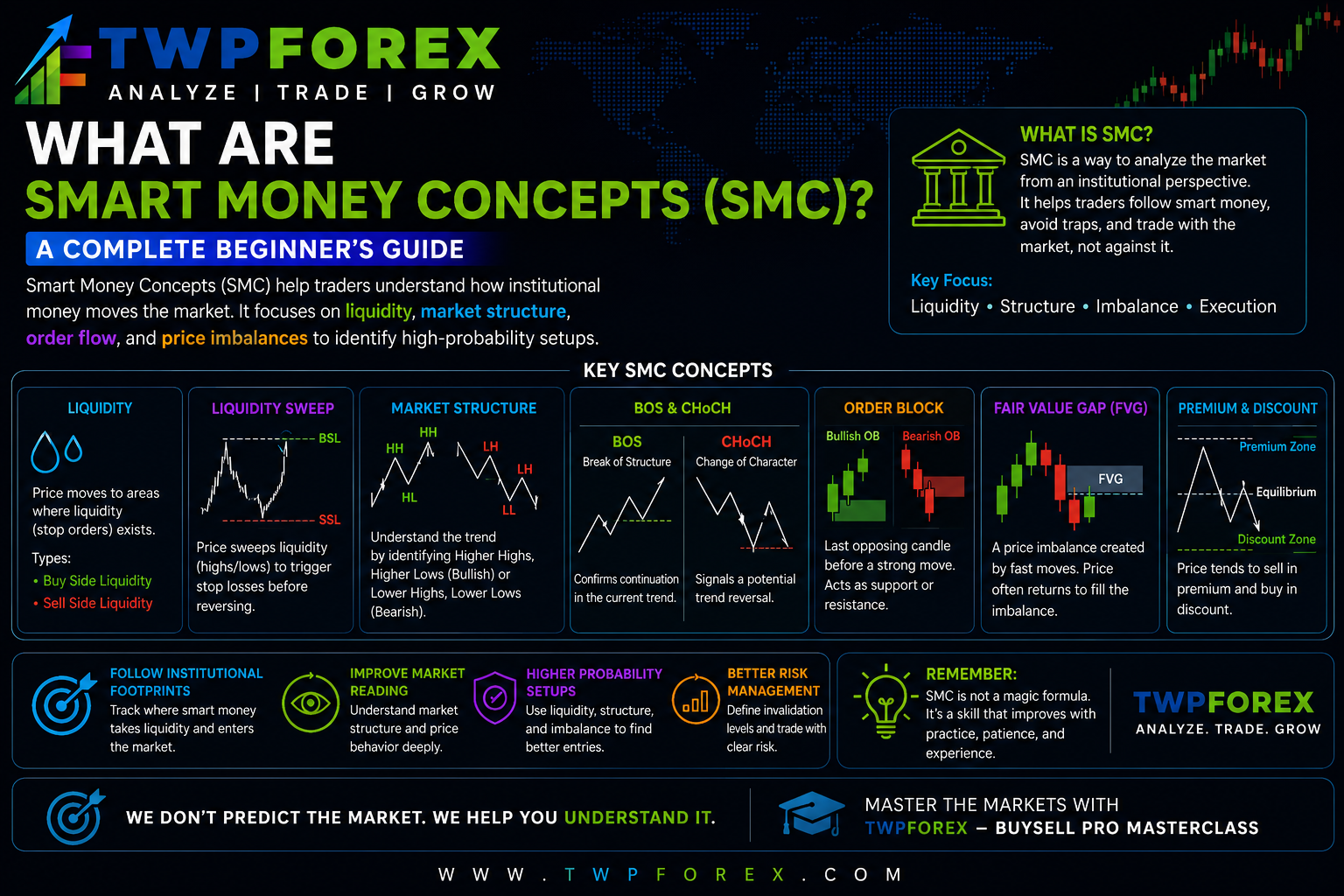
Smart Money Concepts, commonly known as SMC, provide a framework traders use to study market structure, liquidity, price imbalance, and institutional-style market behavior.
Instead of focusing only on traditional indicators, SMC traders study the movement of price itself.
In this guide, TWPFOREX explains the fundamentals of Smart Money Concepts and the key terms every beginner should understand.
What Are Smart Money Concepts?
Smart Money Concepts are a collection of price-action ideas used to analyze how liquidity and market structure interact.
The term Smart Money generally refers to large market participants such as:
- Banks
- Financial institutions
- Hedge funds
- Investment firms
- Large market participants
These participants can execute significantly larger orders than individual retail traders.
Because large positions may require substantial market liquidity, SMC traders study areas where a concentration of orders may exist.
The objective is not to know the exact orders of institutions.
Instead, traders use price behavior to build a structured understanding of the market.
SMC is not about knowing the future. It is about reading the story price is currently showing.
Why Do Traders Study Smart Money Concepts?
Traditional technical analysis often focuses on:
- Support and resistance
- Trendlines
- Chart patterns
- Moving averages
- Technical indicators
Smart Money Concepts introduce another perspective.
SMC traders commonly study:
- Market Structure
- Liquidity
- Buy Side Liquidity
- Sell Side Liquidity
- Liquidity Sweeps
- Order Blocks
- Fair Value Gaps
- Break of Structure
- Change of Character
- Premium and Discount Zones
These concepts can help traders create a more detailed framework for analyzing price movement.
However, SMC should never be treated as a guaranteed trading system.
Understanding Market Structure
Market structure is one of the foundations of Smart Money Concepts.
Price generally moves through a sequence of swing highs and swing lows.
Bullish Market Structure
A bullish market may form:
Higher High → Higher Low → Higher High
This indicates that price is generally progressing upward.
Bearish Market Structure
A bearish market may form:
Lower Low → Lower High → Lower Low
This indicates that price is generally progressing downward.
Understanding structure helps traders answer an important question:
is price currently doing?
What Is Liquidity in Trading?
Liquidity is one of the most important concepts in SMC.
In simple terms, liquidity refers to the ability to execute transactions in the market.
From an SMC analysis perspective, traders often study price areas where a concentration of orders may exist.
Common liquidity areas may include:
- Previous highs
- Previous lows
- Equal highs
- Equal lows
- Session highs
- Session lows
- Swing highs
- Swing lows
Stop-loss orders may also accumulate around visible market levels.
This is why price movement around previous highs and lows receives significant attention from liquidity traders.
Buy Side Liquidity and Sell Side Liquidity
Liquidity is commonly discussed as Buy Side Liquidity (BSL) and Sell Side Liquidity (SSL).
Buy Side Liquidity
Buy Side Liquidity is generally associated with orders positioned above market highs.
Potential areas include:
- Previous highs
- Equal highs
- Swing highs
- Resistance highs
Price may move toward these areas as market activity develops.
Sell Side Liquidity
Sell Side Liquidity is generally associated with orders positioned below market lows.
Potential areas include:
- Previous lows
- Equal lows
- Swing lows
- Support lows
Understanding these liquidity areas can help traders observe where price may encounter significant order activity.
What Is a Liquidity Sweep?
A liquidity sweep occurs when price trades beyond a visible high or low and subsequently reacts.
For example:
Price moves above a previous high.
Buy orders and stop-loss orders may be activated.
Price then fails to continue higher and moves downward.
SMC traders may describe this price behavior as a Buy Side Liquidity Sweep.
Similarly, price may move below a previous low before reversing upward.
This may be described as a Sell Side Liquidity Sweep.
However, an important rule must be remembered:
A liquidity sweep alone is not automatically a buy or sell signal.
Market structure and confirmation remain important.
What Is an Order Block?
An Order Block is a price area that SMC traders identify as potentially significant based on prior price behavior and a subsequent strong market move.
Order Blocks are commonly classified as:
Bullish Order Block
A potential price area associated with a strong bullish movement.
Bearish Order Block
A potential price area associated with a strong bearish movement.
Traders may watch how price behaves if it returns to these areas.
However, not every bullish or bearish candle should automatically be marked as an Order Block.
Context matters.
A trader should consider:
- Market structure
- Displacement
- Liquidity
- Price reaction
- Timeframe
What Is a Fair Value Gap (FVG)?
A Fair Value Gap, commonly called an FVG, is a price imbalance identified through a three-candle price formation.
It can develop when price moves aggressively in one direction.
The strong movement may create an area where price traded with limited overlap between surrounding candles.
SMC traders study these areas as potential zones of interest.
Price may later return to an FVG.
However:
Price is not guaranteed to fill every Fair Value Gap.
FVG analysis should always be used within broader market context.
What Is Break of Structure (BOS)?
BOS stands for Break of Structure.
It is generally used to describe a structural break that supports the continuation of an existing market direction.
For example, in bullish market structure:
Price forms a higher high.
Price retraces.
Price then breaks above the previous structural high.
An SMC trader may identify this as a Bullish Break of Structure.
Similarly, a bearish BOS may occur when price breaks an important structural low during a bearish market condition.
BOS can help traders study potential trend continuation.
What Is Change of Character (CHoCH)?
CHoCH stands for Change of Character.
It is commonly used to identify a possible shift in market behavior.
Imagine a market forming:
Higher Highs + Higher Lows
Price then breaks an important higher low.
This structural change may indicate that bullish behavior is weakening.
SMC traders may classify this as a bearish CHoCH.
Similarly, a bearish market breaking an important lower high may indicate a possible bullish shift.
A CHoCH does not guarantee a reversal.
It simply provides information that market behavior may be changing.
BOS vs CHoCH: What Is the Difference?
The basic distinction is:
BOS → Potential Structure Continuation
CHoCH → Potential Structure Change
For example:
If bullish price structure continues breaking highs, traders may identify BOS.
If bullish structure breaks an important low, traders may begin watching for CHoCH.
Understanding this difference is important because beginners often mark every structural break as a BOS.
Correct market context is essential.
What Are Premium and Discount Zones?
SMC traders may divide a defined market range into premium and discount areas.
The midpoint of the range is often considered the equilibrium area.
Premium Zone: The upper portion of a defined dealing range.
Discount Zone: The lower portion of a defined dealing range.
In simplified SMC theory, traders may prefer to study potential buying scenarios in discount areas and potential selling scenarios in premium areas.
But premium and discount alone are not entry signals.
They should be considered with:
- Liquidity
- Market structure
- Order Blocks
- FVG
- Price confirmation
How SMC Traders Analyze the Market
A simplified SMC analysis process may look like this:
- Identify the higher-timeframe market structure.
- Mark important swing highs and lows.
- Identify potential Buy Side and Sell Side Liquidity.
- Observe whether price sweeps a liquidity area.
- Watch for a structural shift or confirmation.
- Identify relevant Order Blocks or Fair Value Gaps.
- Define a possible entry scenario.
- Establish stop-loss conditions.
- Define the risk-to-reward framework.
- Execute only when predefined trading rules are satisfied.
This creates a process-based approach rather than emotional decision-making.
Common Smart Money Concepts Mistakes
Beginners frequently make several SMC mistakes.
Marking Every Candle as an Order Block
Not every candle before a market move is automatically a valid Order Block.
Marking Every Gap as an FVG: Traders should understand the correct formation and market context.
Trading Every Liquidity Sweep: A sweep without structural confirmation can create poor trading decisions.
Ignoring Higher Timeframes: Lower-timeframe structure can look bullish while the broader market remains bearish.
Using Too Many SMC Terms: Some traders spend more time labeling charts than understanding price.
Entering Without Risk Management: Even a well-analyzed SMC setup can fail.
No concept removes trading risk.
Lorem ipsum dolor sit amet, consectetur adipiscing elit. Ut elit tellus, luctus nec ullamcorper mattis, pulvinar dapibus leo.
Lorem ipsum dolor sit amet, consectetur adipiscing elit. Ut elit tellus, luctus nec ullamcorper mattis, pulvinar dapibus leo.
Is SMC Better Than Traditional Technical Analysis?
There is no universal trading methodology that is automatically best for every trader.
Traditional technical analysis focuses on concepts such as:
- Support and resistance
- Trends
- Chart patterns
- Indicators
SMC focuses heavily on:
- Liquidity
- Market structure
- Imbalances
- Institutional-style price interpretation
These approaches do not always need to compete.
A trader may combine:
Technical Analysis + Market Structure + Liquidity + Risk Management
The most important factor is having a clear and repeatable trading process.
Is Smart Money Concepts Suitable for Beginners?
Beginners can learn SMC, but the concepts should be studied in the correct sequence.
At TWPFOREX, we recommend learning:
Price Charts
↓
Candlesticks
↓
Market Structure
↓
Swing Highs & Swing Lows
↓
Liquidity
↓
BOS & CHoCH
↓
Order Blocks
↓
Fair Value Gaps
↓
Trade Framework
Trying to learn every advanced ICT or SMC concept at once can create unnecessary confusion.
Build your understanding step by step.
The TWPFOREX Approach to Smart Money Concepts
At TWPFOREX, we focus on simplifying market analysis.
We do not believe traders need hundreds of complicated chart labels.
Our approach focuses on understanding:
- Where price is.
- What the market structure is showing.
- Where liquidity may exist.
- What price did after reaching liquidity.
- Whether market behavior has changed.
- Where risk becomes invalid.
- Whether the trade meets predefined rules.
The objective is simple:
Understand first. Execute second. Manage risk always.
These structured principles also form part of the educational philosophy behind the TWPFOREX – BUYSELL PRO Masterclass.
Final Thoughts
Smart Money Concepts provide traders with a framework for studying liquidity, market structure, and price behavior.
Concepts such as Liquidity, Order Blocks, Fair Value Gaps, BOS, and CHoCH can help traders observe the market from a more structured perspective.
But learning terminology alone does not make someone a professional trader.
The real skill is learning how concepts work together within the correct market context.
Study one concept at a time.
Practice on historical charts.
Document your observations.
Build clear trading rules.
And always respect risk.
Analyze. Trade. Grow.
About TWPFOREX
TWPFOREX is a trading education platform focused on structured market learning, disciplined trading principles, and practical technical analysis.
Our mission is simple:
We don’t predict the market. We help you understand it.